Reading John McCrone’s 1991 The Ape That Spoke

John McCrone’s 1991 The Ape That Spoke is a book which holds up fairly closely to my own attitudes. I wish I had read it at the time, 35 years ago. Of course many info-nuggets require updating, for example, all the contexts developed from ancient DNA work on the Homo genus, and the bones of likely Homo species of island South-east Asia, and those recent North-West African fossils, in complexifying the interbreeding of the bushes, rather than the Tree of Man. And computery auto-magic get a mention in gestured intimations of ‘expert systems’. If only.
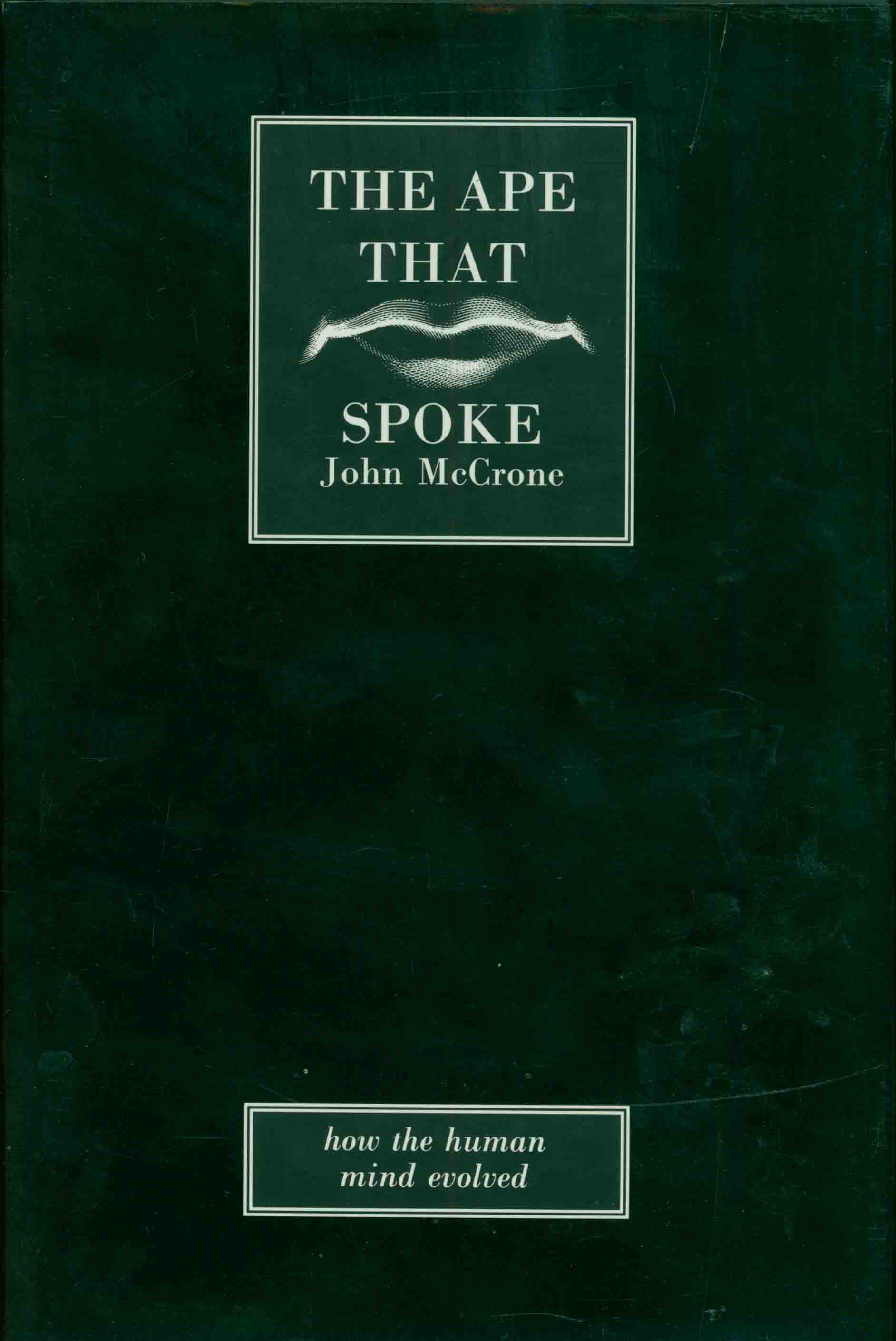
McCrone, John. The Ape That Spoke. London: MacMillan, 1990. ISBN 0333537920
The book still would provide a good entry point into the discussion. And as we say these days, the TL;DR is provided on the opening pages.

page vii ‘Author’s warning’
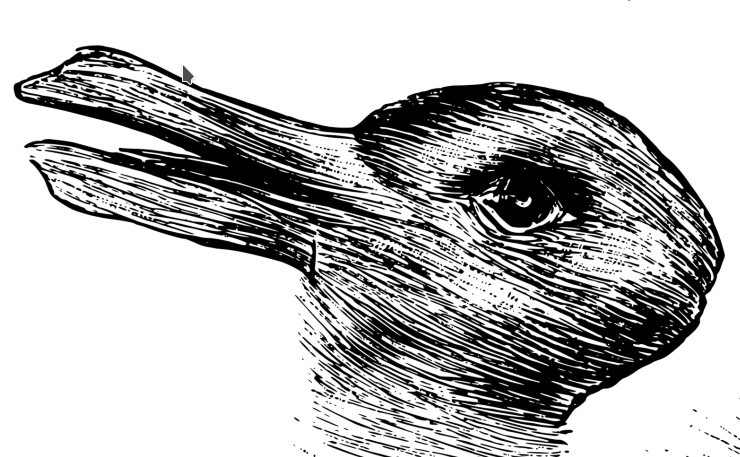
Obviously I think " 'mapping' " is a bad description (by the brain of the world) of the knotty process. See my work on dry pools or getting our ducks in a row for this perspective. A bad description but perhaps an unavoidable starting place.

page 1 ‘Introduction’
In the second chapter on McCrone warns us of “turning verbs into nouns". The warning applies to all aspect of our own individual experience as spoken/writ/proclaimed into the assumed normativities of our peers.The foreshadowing here is that it is impossible to avoid. Ahem.
As this is a part of my morality~evolution set of readings, reviews and reactions, I’ll swing around back to the nouning of morality.
Chapter 8 ‘Watching the watcher’ is predicated on the idea of internalised speech acts as in some way informing consciousness, and thus a conscience, by way of speech origins in social learning. Given the recent coverage of people who lack an internal monologue (an-endophasia) narrating their self to themselves, this position is not without issues to be resolved. One also thinks in contrast, of St Augustine of Hippo amazing passers-by as he read quietly to himself without saying the words aloud. People thought he was not reading as it was not being performed, scripture being a performance art for a long time.
The lack of mind’s eye (aphantasia) in the population should also raises issues with picture-based theories of concepts and intelligence in other writing around the place.
McCrone internalised speech acts gives rise to the ‘moral policeman’ basically a download from the social learning field. A ‘moral policeman’ I guess is a type of superego. Language as a virus type thing I also guess. Morality as a meme.
Chapter four focuses on speech as thinking aloud, which if language is a download and internalised should actually come after chapter 8’s contents. [Also this is biased to how introverts may perceive it: the jibe of ‘extroverts are not thinking when not talking”. See also “inner-speech" above or endophasis or lack thereof.]
But to be fair this is a recursively complex process and published books, as part of that “thinking publicly aloud” (this is what my blogging of essays is about) is presented serially, and most evolution books begin close-by to the ego-writing who is thinking about the ego-reading, and so we get the commonly accept order presented in books published to a market of interested readers…. (evolution… consciousness exemplums…. Self-consciousness). It is more a fault of our whole system going back to Adam and Eve, rather than the author’s fault.
Modern man has, however, become overly impressed by his capacity for abstract thought.” [page 110] [internalised thinking aloud]
Chapter five covers how we and the other apes, and monkeys, gaze into our social grooming contexts (which allowed social learning to emerge between us, from generation to generation and tribe to tribe) and come up with hierarchy maintenance using an inner voice as guide (out of date idea for some have no inner voice as I said) which somehow has to deal with our emotions and motivations. (The cat-calm of a predator was interestingly contrasted with the hyper-agitation of ape based adrenaline-fueled violence). I.E. Emotions as ready-mades or reflex efforts.
So in order to parlay this propensity for action, the intelligence shown in tool use and thus tool making, (those recursive planning skills required for mult-istage processing) …this intelligence is re-tooled in language as recursive social animal behaviour modification and thus negotiation, (meetings) requiring self-consciousness as a conscience, thus we have ‘morality’.
I like this because it has morality as an outcome, you don’t need a gene-for-X. I don’t really disagree with as a crude model, but some of its practical or working assumptions (e.g. inner-voice) may not actually be there, or at least not there until afterwards. I.E. also an outcome in a complex co-evolving mess.
This is a very tricky Gordian knot of a chicken&egg recursive processes of adaptation and development and we we are trying to cut it with the same Gordian knot, and knots are rarely sharp. (Alexander the Great was a recidivist baboon, see below).
And I may mis-represent McCrone’s thinking as his thinking has been published aloud in print as the author and publishers try to imagine what’s ‘good’ for a potential readership of customers. (See what I did there?).
IF we subsume the ‘selfing’ with the ‘worlding’ (that the are the same thing, the same unavoidable meeting on the threshold) there is less need to get these particulars in order, even as the same urge makes us want to “get our ducks in a row”. ‘Morality’ is simply a function of negotiating our urge to self-world among others doing the self-same thing with increasingly sophisticated tools (language, social groups, economies) that support a development of these recursively leveraging tools, because of how they increase the economy. In the same way that the economy was boot-strapped out of the ecology of hierarchical primates by the egalitarian revolution of the paleolithic. A strict social hierarchy would have kept us in a baboon-like state, as big fanged monkey-wolves.
So there is no need to presume the appearance of morality or polity or self-consciousness (sensitivity to sensitivities) or conscience (sensitivity to social-sensitivities) or any other verbing nouned into abstraction as required, nor be required to be explained. This does not mean that these things are a fiction, merely that they are made-up. The pathways to them may be varied, often lost and recuperated, and lost and founded yet again, and impossible to line up into a row of ducks.
I still have to write up about alignment, trajectories and a point-of-view’s favourite tool, where everything looks like a line of flight.
'Footnotes'
McCrone also has an excellent footnote to Chapter 9, ‘Truly self-conscious Man’ on what I have also considered, but probably never written down, so prior art to McCrone.
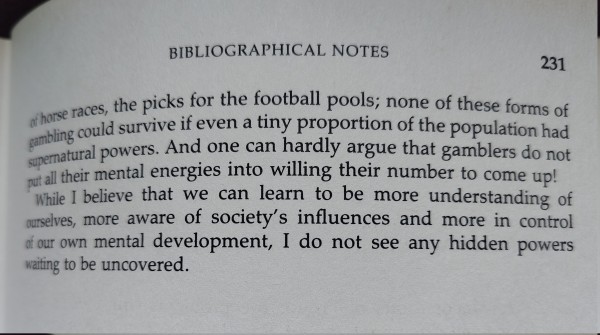
If anyone was telepathic or had telekinetic powers, even just a little bit, they would most likely have more surviving descendents, and the adaptive advantage would spread through the population very quickly, so if anyone had that power, very soon everyone would have it and we would not regard it as even worthy of a mention.
I suspect I was influenced by Douglas Adams story of the Belcerebons, and a massive dig at extraverts who only think when they are talking.
The Belcerabons of Kakrafoon Kappa had an unhappy time. Once a serene and quiet civilization, a Galactic Tribunal sentenced them to telepathy because the rest of the galaxy found peaceful contemplation contemptuous. Ford Prefect compared them to Humans because the only way Belcerabons could stop transmitting their every thought was to mask their brain activity (or its readability) by talking endlessly about utter trivia. The other approach to dampening telepathic communication was to host concerts of the plutonium rock band Disaster Area. Thankfully, an improbability field flipping over the place of the concert transformed the Rudlit Desert into a paradise of psionically suppressive flowers, finally curing the Belcerabons of their telepathy. A Disaster Area spokesman said that this was "a good gig".
References:
McCrone, John. The Ape That Spoke. London: MacMillan, 1990. ISBN 0333537920
Crossposted on substack.com.
This is part of the Reactions to papers/books on evolution~morality series.