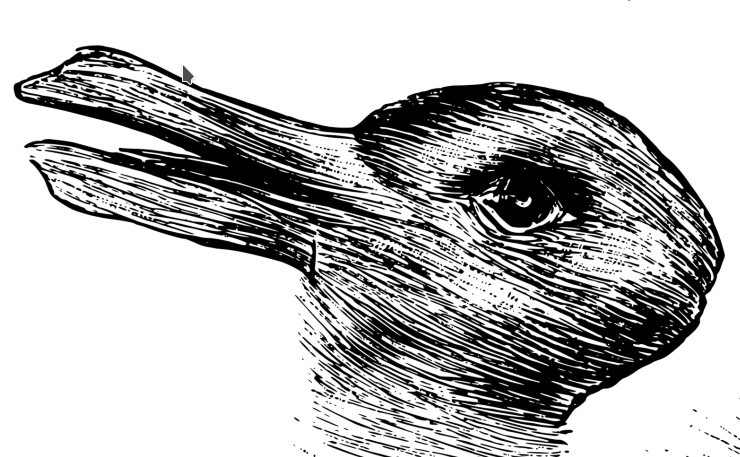
Teapots and cutting boards: the personal occupation of rhizomatic ideal intensities
This one has a lot of set-up and a tiny speck of a glint towards the end.

set-up
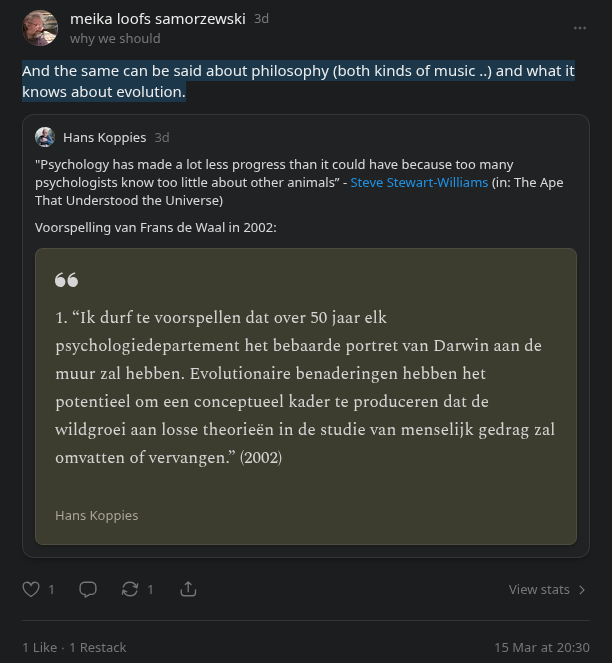
So I made a reframing comment supporting the comment quoting Steve Stewart-Williams (& Frans de Waal in 2002) that psychology has a lot to learn from animals, or studies of them. All that percolates through my head for a few days… —as I visit an elderly father, as i dig up potatoes, as I go to work, as I procrastinate. Even though the thought is a tiny speck.
The link/connection/idea which percolates is that previously I noted that Deleuze is better suited to explore the influence of science and evolution than either analytic or continental philosophy (or tech-grinding and fan-fiction as I label them) because Deleuze & Guattari actually let scientific methodologies in (if only a crack, we can argue about the realness or depth of this notice).
The bloggy framework is that my first post mentions Delueze and I never really get back to him (but see also Deleuze’s immanence: what me-s me to I ?) but spend four or more posts on Iris Murdoch (listed at base of From selfing in worlding to sovereignty: me worlding Iris Murdoch's Wittgenstein).
I say this as a reader, not as any of the above professions that passed me by, scientist, philosophy, psyschologist, excepting writer, maybe …
teapots and cutting boards
In some occupations, towards the end of study, as one progresses from experienced apprentice or journeyer, one produces a masterpiece that show's off one's skills. Notoriously for potters this is a teapot.
For beginners, like high school students in woodwork with their first project, it's more likely to be a cutting board, or a set of coasters.
Both activities of purpose will be quite intense for the student or graduate at the time.
This one is more like the bread board.
the focus
Above I said that Deleuze let's in some science, mostly by way of biological examples, a bit of mathematics here and there, and a sense of life, perhaps without the Élan vital of Bergson.
One of these is the metaphor of the rhizome, whose movements belie the commonsense notions of structure that we humans, as makers, make and like to imbue the world with, as a sort of gnostic and very dry 'meta'- Élan vital, when we seek causal explanations.
In the late 90s on a Deluezian forum or perhaps email group, I made the comment that fungal metaphors would be a better metaphor than rhizomes because they are even more messy and messed up than rhizomes, like say, couch grass. Oh, the indignant heat I received from more dogmatic types. Disciples are the worst people. (See comment below about being an SF reader among literature types).
the joke
In philosophy there is this recurrent dream where a philosopher makes their mark, by making the remark that some more recent philosopher, with the set-up about philosophy being footnotes to Plate, is the last Platonist. The joke being that they are free of Plato, but then the next guy comes along and declares them, in turn, of being the last Platonist, and so it goes on down the generations, all the way.
(The joke will soon be made as to who the last ontologists is.)
the speck of a glint
Deleuze & Guattari use the rhizome to grow a new philosophy, however it is the last gasp of Platonic ideals: smooth, expansively informing, ideal in its imperfections as intensely zoned or piercingly exploratory… —platonic ideal minus the form, just the ideal, the idea of the ideal, and abstraction of that idea or ideal, even if in the negative of the ideal thus forming the ultimate in ideal idealities.
Of course, I'll be next in line for the joke now.
And maybe none of us are the last Plato, because no one was the first one to make do with what they’ve got, selfing the world among others doing the same. A story, a telling; a shelter, a home; a glint in your parents eyes. All the way back.
No Adam, no Plato, no kings.
But maybe teapots all the way down.

references
“Deleuze and Guattari.” Wikipedia 17 Mar. 2026. Wikipedia. https://en.wikipedia.org/wiki/Deleuze_and_Guattari
“Rhizome (Philosophy).” Wikipedia 11 Feb. 2026. Wikipedia. https://en.wikipedia.org/wiki/Rhizome_(philosophy)
meika loofs samorzewski. “And the Same Can Be Said about Philosophy (Both Kinds of Music ..) and What It Knows about Evolution.” social media. Substack.com notes. N.p., 15 Mar. 2026. Web. 18 Mar. 2026. https://substack.com/@meika/note/c-228063445
Deleuze, Gilles, and Félix Guattari. ---
Anti-Oedipus: Capitalism and Schizophrenia. Minneapolis: University of Minnesota Press, 1983. Translated by Robert Hurley, Mark Seem, and Helen R. Lane
A Thousand Plateaus: Capitalism and Schizophrenia. Minneapolis: University of Minnesota Press, 1983. Translated by Brian Massumi.
It's important to realise that, as a reader, I read them as an SF reader who had read Hofstadter's Gödel, Escher, Bach… — and not as an art student or english lit undergrad.
Crossposted at substack.com
See also posts on philosophes and politicos