Clans of the idios kosmos
One thing to remember about the word idiot is that it does not, in that ancient Greek context refer to the intelligence or capabilities in political efforts of an individual, merely their private status, their personal efforts, perhaps compared to those who hold, or are qualified to hold, public office and so engage in public life. Back in ancient days when the world and politics were possibly quite synonymous with the horizon of one's polity, the polis, the city-state, and the difference between trade, tribute and piracy was moot.
Now in comparing those more private people, who “by choice” withdraw from a more public life, they may well be illiterate or ignorant, or just dyslexic. It is thus, in the English we inherited the French, where the addition of stupid is made to 'not sophisticated' (enough to hold office), and then we all doubled-down on it all to mean mentally deficient. The description becomes abusive, the label diagnoses.
We still get a sense of the Greek usage in the term idiosyncratic to describe moments where someone holds strange or unusual: habits, ways of behaving, or features. As in, perhaps: less polished, less worldly facing, more selfly, more interior, inaccessible.
A surviving Ancient Greek phrase illluminates this as the Idios kosmos (ἴδιος κόσμος), refering to people’s ‘own world’ in contrast to the “common world” (koinos kosmos) where things like politics live.
Another contrast is the private world of sleep held in comparison to the world where we are all awake. As such Idios kosmos has collected, in the last couple of hundred years, usages referring to those very indiosyncractic experiences of the world provided by mental illness, where those dreams enter the waking world as delusions.
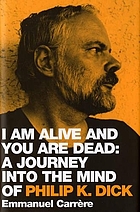
So I found this term ‘idios kosmos’ when reading Emmanuel Carrère’s I Am Alive and You Are Dead : A Journey into the Mind of Philip K. Dick. (Translator: Timothy bent. London: Bloomsbury, 2005).
A few days before reading it, as I woke into a that less unconscious pre-waking dreamy thinking I do early in the morning, when not stressing out too much and it punches the sun up too damn fast… —I saw bursting in my mind’s eye a graphic, a graph, that parted with a line of variable thickness, two areas of the selfing the world, and worlding the self. On the diagram below let’s ground the self, and sky the world, now Dick is a spirit in the above.
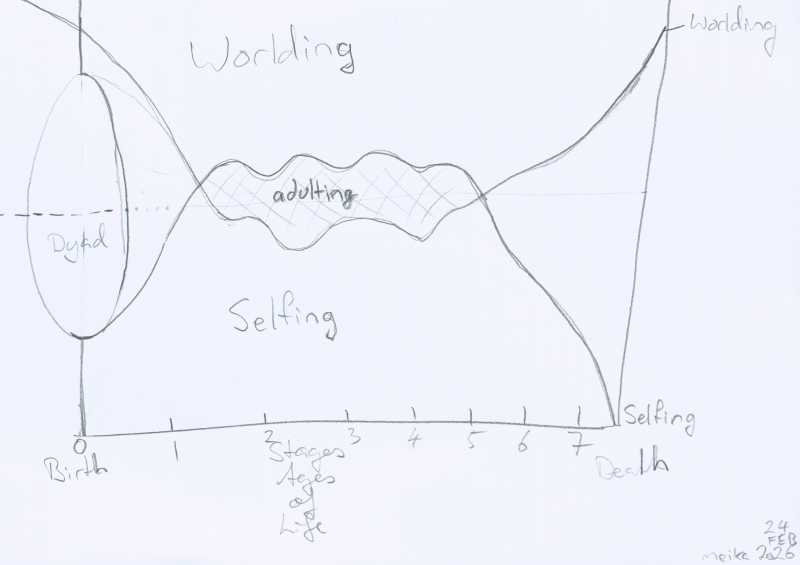
I should add at this stage of the post that the following hand-drawn diagram is the whole point of this post. The rest of it below is just context for a visual way to describe the proportions of the ratio (self:world::world:self).
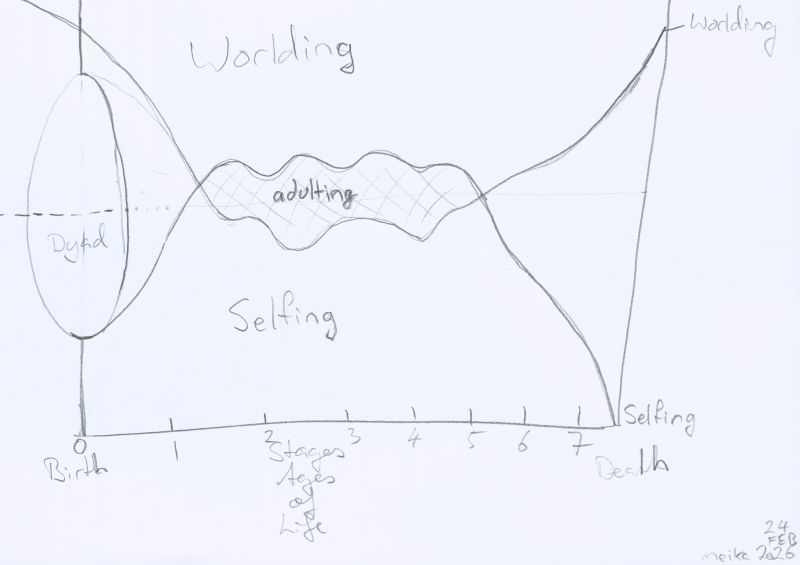
The line starts nine months before zero, as a nod to how these things, all-things, arise in originary interdependence. The x axis maps time, either in years, or stages of life. The vertical y axis is also limited, not by death as is the x axis at the end of the seven ages of a human’s lifepath, but by the end of the world, which might go beyond infinity if we are feeling expansively spiritual, or less than that if we worry about how much reach a self can be cognizant of when it comes to worldly things.
The variable width of the lifeline is the important bit, the width of the line, rather than just the area above or below the line.
Before birth it is thinly spun in, or out, of the mother and her support network, invisible if not hidden. After birth it thickens as it separatesout of the dyad of mother/child into the family (as the umbilicus rots), and from the family into adolescence (as the child disintegrates), and then the world. The thickness is a indication of selfing the worlding when worlding the self. Give and take, push and pull.
(self:world)::(world:self)
I suspect the main influence on this idea are those history of life or pathway of life graphs.
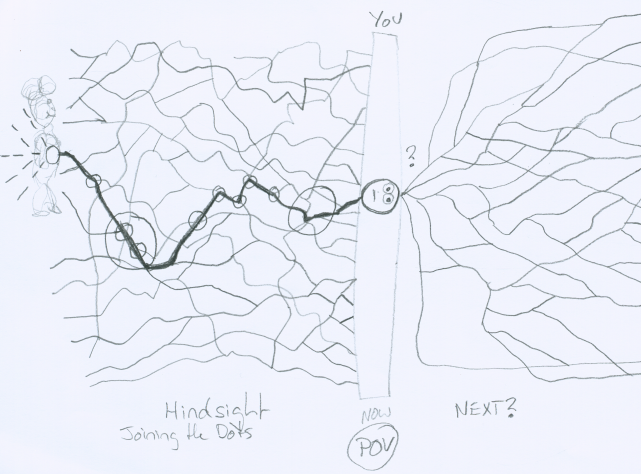
Everybody’s line differs according to their life history. Twins maybe not so much… one tries to suggest. You can read the diagram as a map of possible choices or options with the thick line being the one actually made by an individual I am calling 'you', or reconstructed in hindsight by joining the dots by all of us.
But you can also see those other lines as the ghosts of other people in your life, if not their own life-path-ways. The z axis can be a whole set of complicating options and variations. So we will ignore it for now.
Philip K. Dick’s wrote in “If You Find This World Bad, You Should See Some of the Others" :
“Often people claim to remember past lives; I claim to remember a different, very different, present life. ...I rather suspect that my experience is not unique; what perhaps is unique is the fact that I am willing to talk about it.”
We can see this as either multiple lines running serially or in parallel, or both, or in the case of schizophrenia — - dashed …or unjoinable dotted lines. Some are not blessed with hindsight, which makes sense of something that doesn’t.
These are not maps, they are illustrations of a map that is in fact the territory.
Emmanuel Carrère’s ‘biography’ I Am Alive and You Are Dead : A Journey into the Mind of Philip K. Dick tries to capture that by the retelling of Philip K. Dick’s life by way of his storytelling. Carrère reworks lines and story titles into each chapter heading of the ‘biography’. That's how Carrère joins the dots as a biographer are expected to do.
I was sad that Clans of the Alphane Moon did not get a heading directly.
A novel where, in an interstellar cold war turn heated, an abandoned satellite-based psychiatric institution provided colonists from other Alphane system worlds unable to cope with the stresses of colonisation seeks its independance from Earth.
The set-up? The inhabitants of Alpha III M2 each world their politics in clans, each clan groups each patient according to their diagnosis. Only offworlders do not have a diagnosis. A caste system by diagnosis. A rose by any other label.
Think about that.
I re-read the novel recently, and the use of now outdated categories or labels of mental illness for some of these clans was very illuminating.

Other posts on the self:world and their ratios are listed at Posts on Janus ratio, or what's the point? and Posts on selfing / agency / individuation. In addition there is also Posts on writing, consciousness and altered states.
Crossposted at substack.com
References:
Emmanuel Carrère. I Am Alive and You Are Dead : A Journey into the Mind of Philip K. Dick. Translator: Timothy bent. London: Bloomsbury, 2005
Philip K. Dick.
--Clans of the Alphane Moon. St Albans: Panther, 1975.
--“If You Find This World Bad, You Should See Some of the Others.” in The Shifting Realities of Philip K. Dick: Selected Literary and Philosophical Writings. New York: Vintage Books, 1995.