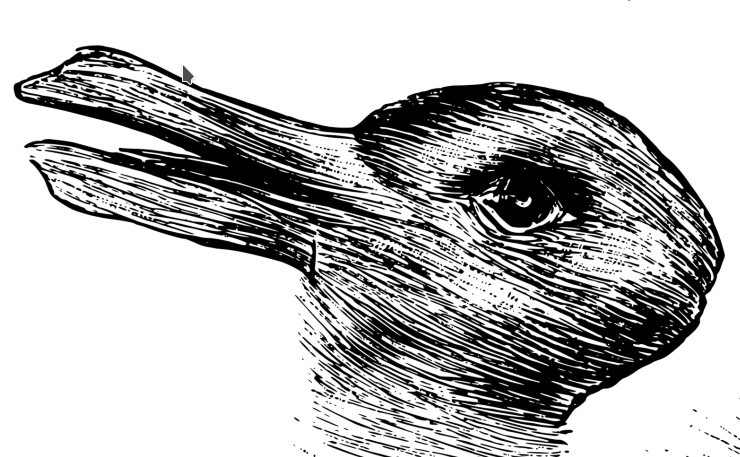
Footnote to Alignment ② definity on POV, preposition & pronouns

This footnote to Alignment ② definity is part of the alignment entry in the [taphonomy of worlding] project.
Since Alignment ② definity I’ve actively been looking for a better term than Point of View, and my puny point of view is failing me. Written in July/August 2025 and here I am in October 2025 and no better off. So much so I forget what I have written on it before. I forget. Me forget…
What about you? Or yous? Social learning for the win after all. Many eyes make all problems shallow.
Who are you again?
This footnote seeks to show connections between disparate things we describe in the world that form some sort of unifying but disperse thread of appearances.
In short, it is to say, pronouns are just mutant prepositions.
We distinguish where with who (i.e. that where = who) but this occludes their similarities (compared to how or why). And that by saying pronouns are prepositions we can acknowledge the POV within the grammar of our speech (how would gossip work otherwise?).
Now I am not saying that prepositions evolved from pronouns, after all, many languages do do use prepositions per se, but have other ways of dealing with relationships and vectors of connections between parts of the world we apprehend. It’s likely that it took a long time to distinguish as much as we have and in that time prepositions come and go even if the job they do does not.
The 'some' of us are given to attacking our own projections of self into the conspiracy of the world we cannot control, as heros in our own lunchtimes, by personally identifying or labelling our own POV as a particle of grammar, perhaps a pronoun. Now use any pronoun you like, but identifying with any element of our language essentialises and reifies stupidity. Banning it is even more conservative. Both traditional and transgressive modes surrounding pronoun usages are fundamentally conservative and are unwise.
Why do you want to be a particle of grammar? Why do you want to harden the worlding mistakes of the past? The whole argument is violent in that it encourages violence, on the excuse of violence, thus it begets violence.
If I were to make a more fundamentalist grammatical claim, following my assertion that pronouns are just uppity and re-purposed prepositions, and I really believed that evolutionary pathway (which for the literal-minded Americans and Russians in the audience I’ll state that I do not), and said that my preferred pronoun is a preposition : where/wherefor and whereto in the ablative case and please use those forms when I am in the room and you are addressing me directly— i.e. do not refer to me as ‘you’, those are who-ist oppressions.
So instead of saying “would you like cake with your coffee?” Be thoughtful and ask, “Would where like cake with wherefor coffee?” Or, “Are where warm? Should here put the heating on?”
Note this is a very different claim to Marjorie Taylor Green’ s bitter identification as a frog, which doubles down on the conservative nature of essentialist claims to defend against equally essentialist but transgressive categories, burdened as they are by an unawareness of what my claim, my poetry, that pronouns are uppity prepositions allows us, if not heres, to our POV, which the pronoun debates does not deal with at all, and as a 1970s child I miss all that androgeneity of flowers and love and experimentation.
See also asking an LLM about pronouns and Marge Piercy's Woman on the Edge of Time (or substack.com from March 2023). It had no clue about the pronoun 'per' because statistics.
Of course this debate of pronouns is all ruined by resorting to the law as it fails to cope with changes to our social institutions. Social learning for the fail.
The moral linguistic poetic rant is over, now for the philosophical implications of working through the options that pronouns are uppity prepositions lost in the world.
The connection here is that language works from a point of view, which we often occlude.
The bread is in the oven.
This reports a fact but occludes the context. At this point logic can take off and develop into entire rituals of occluded speech, useful in a general sense to disciplining mathematics and and procedural processes, which are held in common in the world of all our points of view. But just because they are occluded they should not be forgotten.
What is occluded?
(pronoun) (verbed) the bread in the oven.
Which pronoun? Well it depends on a lot of social facts, even if they are transgressive froglike facts. Generally we think of pronouns as substitutes or shortcuts for nouns (pronouns = for-nouns) and more recently as Proper Nouns by way of identification rituals and prayers.
But the real work is to locate speech acts, and those acts referred to in speech, by speech, for speech.
Pronouns are performative rituals to maintain the world. But they do not have to be, and I argue that they should be as unnoticeable and thus non-essentialised as prepositions (remember my claim that pronouns are prepositoins is poetic and not to be taken literally even if I think it is an accurate way to look at pronouns rather than as substitutes or short cuts for nouns per se.)
Damn, went into rant mode again because of social facts…
I.E. if we occlude POV then rant-mode will return from its sup/re/pression all the time, and logic doesn’t help when we live in sub-optimal potholes of language use in deference, defence and attack. Bad work in the lek or arena or noyau. Bad worlding.
If we ackowledge the occlusion then we can wise up to the trouble 'they' cause.
Pronouns are prepositions because they place us in the world just as we place everything else. It's always about a point of view. Reifying that into an identity is bad worlding because it is bad naming, bad nouning, bad placement. It chops up the world into nasty bits and pieces, needlessly.
Don't forget the world.
Substack posts on this are at Alignment ② definity defining the []closure and Alignment ② definity 2.2 and this footnote at substack.com
Postscript October 2026
I feel I am getting somewhere. Mostly after ruminating on the physicists Julian Barbour (e.g. see Minimum viable product) and Frank Close's Lucifer's legacy: the meaning of asymmetry (see Alignment ⑫ a/symmetry).
The shortest form in getting somewhere: A point of view (POV) subsumes the world into itself.

Or, longer, a point of view subsumes the world as a secondary subject, the outward sense and not quite abject, and so easily confused with object, the point of view is thus often then solely attributed to the subject when we throw the world out as object out 'there' [reification?]. We then trap ourselves in this unstable state, for in subsuming the world into itself the (POV & world) begin a flickering existence (a type of intersequential blur) (so if not trapped then alienated or spooked).
[(POV(world)) :: ((POV)world)]

To repeat this with a linguistic turn: A point of view subsumes the world into itself — we get trapped there. (Trigger warning: pronouns ahead)
Here the word "itself" is a tripwire, as a reflexive pronoun doing a lot of Janus dancing, between (POV(world)) and ((POV)world). In one moment of attention it looks like flipping out (POV(world)) but then flips in ((POV)world) and so forth and so on, or vice versa.
Without empathy to share the effort there is no end to it, the butterfly is dreaming it is a butterfly, the world and the self are not distinguishable. This is what a prosocial species takes on in order to survive. Otherwise fear and anxiety must do the rest for an animal's POV::umwelt.
It is empathy which create the specialness of a baby, some can not grow out of being special. Narcissists should really be regarded as a type of Darwin award candidate (being unable to distinguish between the POV of self and world) except they can take the world down with them when they go.