today to world
When we see the day in our world and the world in our day, we have no need to should.
One might say we should… —should, but this is too much. Chill. Relax. Smile.
In giving this moment to the day we are open to the world.
The biggest part of the world is the day.
① the day in the world
② the world in the day
③ in the world at home
④ at home in the world
In ancient days there was little to tell apart the world from the home, the home range from the village, the house from the hearth, the mother from the child. A time so long ago it might as well be in the future.
So when we first self out into the world we take home along with us at last. We rarely get to the end of the world, and the realm does end but that is beyond us. Importantly before we get to the edge we meet others coming our way. Here we self to each other, each worlding the self among others doing the same selfing of the edge of the world. There are no clear edges, the world moves among us as we leave home behind us.
Thus worlding is not necessarily selfing for others. It is not necessarily a trade-off, even as it apportions ratios and reason.
Worlding the self is the way we move among others doing the same work, the same life; what it is to be alive. There is good and bad and better and for worse worlding. Remember worlding is an effort among others. The effort produces many things, first of all the world itself from the effort we live in surviving, those who do not make the effort do not have a life. This is the worlding urge. Whether it is good or for ill is a choice we make. It is not that we should make this choice good or ill, even if we often do, and oddly confuse the outcome with the urge.
This can be bad worlding.
This dogmatism is common to bad worlding, and some would wisely say, like Pyrrho of Elias, bad for selfing. They world too much, or, at least they world too hard, and this anxiety becomes a mindset, a heart set in stone. This disrespect is common to bad selfing for selfers who see no worlding for anyone, especially a poor me, and smile inwards in hatred, with a rock in hand that is their heart.
Worlding is an effort of selfing among others, and we 'should' all that into social forms. The variety is endless, the effort is survival. The social forms are not just fashions or modes or registers, but functions, specialisations and complexes. They differ us as they differ among us, and our groupings, across geography and through society. They differ the world from the day, the home from the unknown into tomorrow: religion, art, performance, polity, economy, home…
Just as the day breaks with a parting kiss, the world rhythms that into a rhyme, and we make our own way. Even when we cringe, we feel the pain of a worlding… — we feel the effort fail to value itself. There is pain in bad worlding, and some only have pain with with to pass judgment.
Just as the evening meal kisses the day into night, and we share these daily prayers before we dream them into tomorrow, here our day becomes a part of the worlding among our others.
References:
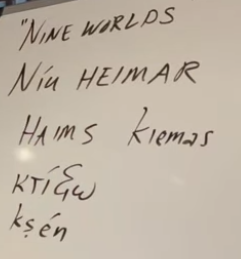
The “Nine Worlds” Problem in Norse Myth. Jackson Crawford, 2025. YouTube, https://www.youtube.com/watch?v=lbgZBSMZ9Fk. (The English word 'home' develops from a Germanic sense of the home range as world, where your entire civilised world is a village or two, or maybe just a campfire where we lie together worried about barbarian monsters.)
Everything written and listed at Posts on the world, worlding.
Crossposted at substack.com