Liveliness - Lougheed
pre-put
Back in September (2025) I read the following piece on the new work in philosophy channel.
"A Moral Theory of Liveliness: A Secular Interpretation of African Life Force" by Kirk Lougheed.
Fellow in Clinical, Organizational, and Research Ethics at the Center for Clinical Ethics which is housed at Unity Health Toronto, Academic Fellow in the the Department of Family and Community Medicine at the University of Toronto, and a Research Associate in the Department of Philosophy at the University of Pretoria.
So I ordered the book, in fact, I pre-ordered the book, a rare thing. It arrived a couple of weeks ago, sat around, and went to read it after needing to rest my thumb… —having cut it with a bread knife and a bad aim. A libation so made.
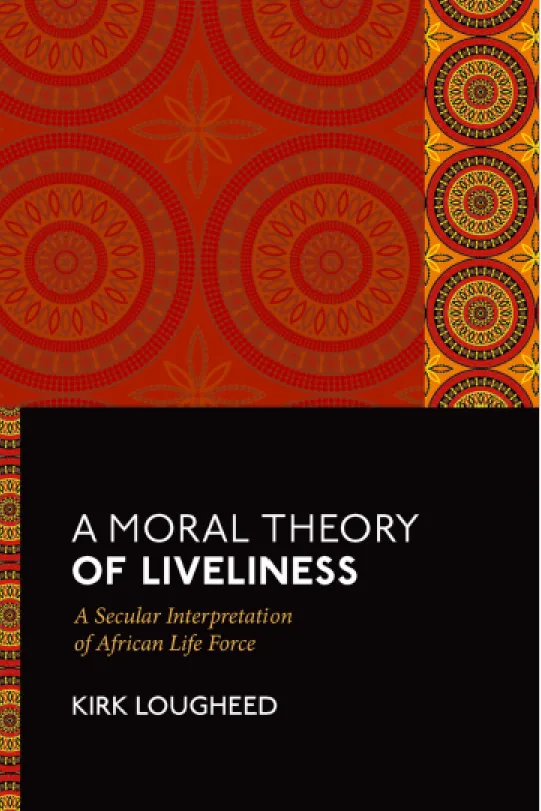
I partly hope this is evidence that I read more analytic philosophy than I do continental. The fudge here is that I class a lot of continental philosophy as literature, if not fan fiction, rather than ‘philosophy’. So some one else watching from nowhere and counting what I read may come up with different proportions.
Generally, I enjoy reading literature more than the ratchet tech-tree lego-block minecraftian constructions that are analytical philosophy monographs. But then I read less of all sorts of 'literature' so enjoyed. Reading is work now.
input
From my notebook:
page 62 ‘The purpose of this book is theory construction, […].’
Lougheed’s aim is to write a introduction to the future effort and work required to bring a secular notion of liveliness (itself a meta-value or effort) without necessarily bringing along, nor leaving behind, notions of what life-force is: that liveliness illustrates, or, dare should I say, animates. Life-force as a life-based metaphysics is not explored in extent, dominion or cause, this is analytical philosophy after all.
The theory construction is to proof liveliness against various traditional ethics approaches in analytical philosophy, as such it works as a potted surprise of ontologies. The main two used in comparison are teleologically and deontologically based, which we can crudely label and contrast by their vectors of intention. In teleological efforts the vector of intention is towards some outcome (like utilitarianism, or perhaps consequentialism or salvation). Deontological vectors however are projected from some point with which we are in some manner assumed to be causated by, and this assumed origin of intention is, perhaps, some vastly more powerful, or perhaps merely, more good goodness. God/s commands us to be good. (See my stuff on alignment as to why we do this).
Left unsaid, or silenced, is the vehicle of time which all vectors require. Also unsaid is the effort required to set such vectors into motion, and what landscape they might move over in gaining direction, if not construct the world into reality among us in the same way that dreamtime figures move mountains and sculpt rivers in the dreaming.
Teleological approaches are based on hope. Hope is an effort. Assuming effort will be rewarding, or rewarded, is unwise.
Deontological approaches are based on respect. Respect is an effort. It respects effort, especially past effort, and efforts so often captured and capitalised by the unwise hierarchists among us.
I am by nature more teleologically biased, hope springs eternal. Lougheed notes he is more inclined to deontological moves, respect earns his respect.
However both these biases are somewhat overcome, by acknowledging them in contrast rather than identifying with them.
Thus it is that Lougheed ends the book with a move into Michael Huemer’s Ethical Intuitionism which I will now have to follow up.
Throughput
So what is this secular liveliness that is proved against these ethic frameworks in a metaethics?
It is to be found in post-colonial African philosophers working from within their various African cultures in university level philosophizing. Liveliness describes a value, a good, which is common to many sub-Saharan cultures, and where it’s increase is a moral good. Liveliness is, in a sense, a moral measure, or reasoning about how we should should.
Liveliness increases when goods things are done, and judges behaviours or outcomes as bad where that capacity for liveliness is diminished or destroyed. As a measure, a human is valuable to the degree it manifests pro-social liveliness, both in expression and in responsibility for this expression in others. It assumes we are a social learning species. It also judges that liveliness is directly related to the interconnection of our relationships, and liveliness is increased when our communities are enhanced. Consensus hopefully enhances liveliness, as does respect for age-garnered liveliness.
Retribution does not enhance liveliness. Living a solitary life probably does not. Family life definitely does, community life should then be more 'communitarian' than 'market' based, or at least anonymised market-based.
Re-pre-put
Liveliness is a welcome re-valuation of all values in this attempt to investigate what is called moral philosophy.
Moral philosophy is a pot-hole I met along the way here. How did I get here?
As I see effort as the unspoken dynamic of our values, where in each and every instance, in expression and reflection, effort is a movement which captures the movement of the flow, which then can recursively intensify and generate complexities; which we call life and its sensitivities (survival and its attendant partialities i.e. points-of-view and our conscious experience as an interiority of intentionionalit/ies).
Mine is an epistemology first position, within which ideas more ontological are the outcome of evolutionary processes, and that the view-from-nowhere is misguided and untruthful as an assumption. But evolution has no care to sort that out. Partiality is more truthful, even while I appreciate the efforts towards objectivity among and for us. Objectivity is a type of partiality.
Thus I see liveliness as a good description of an attempt to incorporate effort into a sense of worlding, which so many of us call morality. Especially it’s pro-social assumptions for a social learning species. Calling these communitarian or collective is perhaps saying a little too much.
Liveliness attends to effort directly. As such, in my framework where values arise in attempting and reflecting on effort: to live, to nurture, to work, to meet; Lougheed’s secular working through of liveliness in an analytic philosophical framework among African philosophers is very useful. An excellent effort.
Rather than this secularization being see as a removal, and thus lack, of ideas of life-force, or some variety of animism or elan vital, it would be better to see this as a de-onotologicalisation wherein our propensities to see things not as meetings and expressions but as objects is undone.
We often assume too much. Life-force assumes too much. A universal objectivity assumes too much, regardless of either being devine or not. I.E our short-cuts of animal-grade effort (e.g. the grammar of being, to be, ontos) which help us survive should not over-determined into existence generally. But effort cannot help but to do so, as it shoulds [pdf].
Lougheed has an announced preference for the ontological, at least over teleological, processes and this may come naturally to him. Biases and preferences are a type of effort inherited and nurtured. Ontology-prime efforts reflect /express the values of respect. Teleology-prime efforts express/reflect hope. Both are require for a social learning species to survive. They will remain aong us as long as we are speaking to each other.
Lougheed comes to some variety of a suspension of judgment between these and other more anti/realist dichotomies, and ends with some reflections on Michael Huemer's Ethical Intutionism, which I will have to follow up.
References
Arvan, Marcus. “‘A Moral Theory of Liveliness: A Secular Interpretation of African Life Force’ - Kirk Lougheed (LCC International University).” Substack newsletter. New Work in Philosophy, 1 Sep. 2025, https://newworkinphilosophy.substack.com/p/a-moral-theory-of-liveliness-a-secular.
Lougheed, Kirk. A Moral Theory of Liveliness: A Secular Interpretation of African Life Force. 1st ed, Oxford University Press, Incorporated, 2025. K10plus ISBN.
Hippel, Matt von. “Cosmic Paradox Reveals the Awful Consequence of an Observer-Free Universe.” Quanta Magazine, 19 Nov. 2025, https://www.quantamagazine.org/cosmic-paradox-reveals-the-awful-consequence-of-an-observer-free-universe-20251119/
Huemer, Michael. Ethical Intuitionism. Basingstoke: Palgrave Macmillan, 2005. cited in Lougheed 2025.
Crossposted on substack.com
See also the listing at posts on philosophes and politicos.
by put
in between the book arriving and my reading it I thought a lot about performance, and how our streets are the main stage (if all the world’s stage, most of it be side chapels). Some people say we need religion, usually in reference to spiritual efforts, sometimes in reference to community-building exercises (thought-police confuse the two). But if we think out religion from this second reference then we are talking about performance, and if we de-segregate it from churches or the workplace, we are left with the street, which in so many places is just a road for our love affair with cars, but even if we are on the streets of a walk-able city, we may miss the main event. Liveliness is a way to describe what is lost or lacked, and that is what we need rather than religion, that which builds spirit. ‘Performance’ was not covered by this book perse se but that is what I was thinking about when reading it. (crossposted note at substack.com).