Shiny traps

This follows on from Remember the mirror is just a very dry pool.
Dry mirrors were first made en masse in the Neolithic, as a product, as a shiny thing, as amulet and ward, as a copy of the water's eye, for those wishing to abstract the reflection one might see in the surface of a pool, but made for the hand to hold, by an hand with a glint in their eye… —on their customer’s wanton gaze.
I say Neolithic, but that is what we have found to be the earliest. Things tend to always go back before we have evidence for. This statisical reality, this liklihood of the commonplace being available to us, or not, is not evidence for anything mythical being less mythical. Things always go back further than you think, but not as far as you hope. Hope is for the world tomorrow anyways.

The dry mirror’s surface was a magical success where depth and complexity are excluded and an analytic objective world is is indicated, if not indexed into “being”. A trap for the unwary that ensnares both the objective reality and its children, the ideal forms, and into whom, both parent and child, the hermeneutics of existence mapped onto language also fall prey, in many subsequent and derivative moves. Recursively, recapitaluting ontogeny. The trap lies in forswearing any acknowledgment of the taphonomy of appearances which a mere pond suffices to illustrate.
In “analytical” philosophy this drought is seen as its strength, a weakness borne as a virtue, after all it requires often strenuous effort to survive the aridity. In “continental” philosophy a reflection mirages the arid plain back into an illusory moisture, salvation beckons, hope lies to us, no more wet. The worlding urge is strong…
The wet and dry dreamt complexities of the self still seep unconscioous of the worlding the selfing “requires” (at its own abconscious urges). We steep in ourselves, tools in our own machines, fools forever.
The mirror is not a mistake but a successful trap of our own invention
The worlding urge is an uncaring scourge, in that its successes are pitfalls, pot-holes, and the dry ponds of our own open graves.
The afterlife is everybody else not yet dead.
In the mirror is just a very dry pool I was quite taken with my (‘open’ grave = “dry” pond) analogy in deprecating the mirror as invention and tool. And when questioned about mirrors and their first appearance in the record, the bronze mirror came up, and I nod like a daffodil, but in looking into this I discovered that older polished obsidian mirrors were found at Çatalhöyük, and elsewhere, perhaps four thousand or more years earlier. So mirrors could be seen as part of a neolithic phase change. Even the suggestion that the first deliberate mirrors were fired earthenware pots fits into that.
Except of course, kelp water carriers would have done the same job. Things go back further than you think.

Then I looked into the myth and the word ‘Narcissus’ itself. Now, the best known version of the story comes from Ovid’s Metamorphosis, that work of exile, but in its basic form a hunter out and about catches their reflection in a pool and… —becomes the flower that inhabits damper places where a pool may lie still and reflective. There are scholarly arguments about the name as word and how pre-Greek it is. There are even more complicated re-tellings which give us pathologies like Narcissism, if only because the flower so named Narcissus nods in self-admiration, or shame.
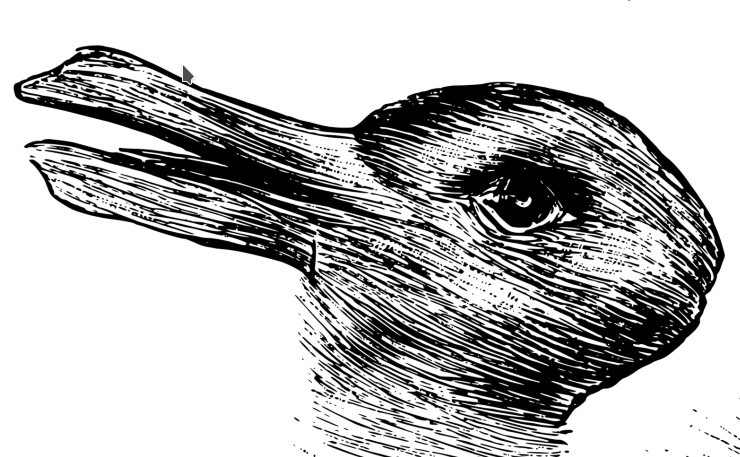
This quick summary of the duck-rabbit hole began with a footnote or two at wikipedia's Narcissus_(mythology) entry. It lead me to reframe the story of the hunter lost in a reflection. If mirrors are not commonplace, your reflection may not be recognised as such at first glance. It’s just a face staring back at you. A good joke for later back at the fire for the evening meal. It’s in the re-telling the story grows into myth and all the attendant worlding work we layer onto it, for purposes the original joke allows but cannot predict. Fools that we are.
The key reframing of this duck-rabbit hole is that the other person, in the water dies once recognized by the rustic hunter. Versions of Narcissus' story belabour this in different ways. Here is one revisioning from that wikipedia footnote (retrieved March 2026) mentioned earlier:

In the basic story, the hunter catches a view of someone, that turns out to be themselves, in a time when mirrors were not commonplace at all. This lingers in Ovid. But the gloss, the scholion, turns mythmaker, mirrormaker, the dry pond of an open grave digger, speeds the empathy-buidling and moralising fiction around worlding as fast as a lie. The truth is buried in past.
The death by recognition, or satiation of desire, and transmogrification of that as a nodding flower certainly reinforces the poetic analogy (‘open’ grave = “dry” pond), or even metaphor if it transports you/me/one. The re-framing will also carry me through any new readings of the story post-Freud… —looking at you Lacan, Girard and their lackeys.
I’ve sometimes caught myself unrecognised in a shopfront mirror, and a little bit of me dies when I see who it is. How it is. That’s the original stone age joke BTW. Not the narcissism.
I've friend who have caught themselves in a shopfront reflection on occasion, and then were shocked they were not a women at all.
Of course narcissists never catch themselves in the mirror as they can never see the world looking back at them. Narcissism as a pathology should be re-framed as an inability to world, defining it as self-love only misses the point (selfishly) entirely.
It's also possible the original hunter catching sight of themselves did so in water carrier placed near their mother's deathbed.
Now there is a myth.
References
Dimosthenis Vasiloudis “The World’s Oldest Mirrors Found in Neolithic Çatalhöyük Site!” The Archaeologist. N.p., 6 Aug. 2022. Web. https://www.thearchaeologist.org/blog/the-worlds-oldest-mirrors-found-in-neolithic-atalhyk-site (nice site, not much enshittfying advert page-spam)(supplied the pictures)
Alice Vinet. “Neolithic Obsidian Mirrors from Southwest Asia: A Reflection on Their Diffusion and Manufacture.” Journal of Archaeological Science: Reports 62 (2025): 105047. ScienceDirect. Web.
Louise Vinge. The Narcissus Theme in Western Literature up to the Early 19th Century. Trans. Robert Dewsnap et al. Lund: Gleerups, 1967. [facsimile]. Vinge is quoting: Joachim Schickel’s article ‘Narziss zu Versen von Ovid’ in the journal Antaios 3, 1961/62 p486-496
Callan Morse. “ ‘One of the Most Significant Aboriginal Items in Any Museum Collection’ Returned as Ancient Kelp Water Carrier Is Repatriated to Tasmania.” National Indigenous Times. 23 Feb. 2023. Web. retrieved 7 Mar. 2026. https://nit.com.au/23-02-2023/5067/one-of-the-most-significant-aboriginal-items-in-any-museum-collection-returned-as-ancient-kelp-water-carrier-is-repatriated-to-tasmania
Crossposted on substack.com
This is part of the taphonomy of worlding