"The Ideological Brain" and 'Can psychopaths be fixed?'
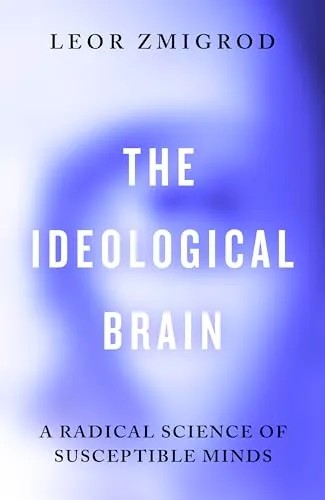
A major thread running through The Ideological Brain, by Leor Zmigrod, a detail of Charles Darwin’s intellectual biography.
His marriage to Emma provided Charles with a distinct contrast to his scientific work, and that emotional commitment provided much of the delay in the ideas of natural selection and its implications being published. For Charles had made an agnostic commitment to Emma not to disrupt matters of faith, but he eventually slipped-by this, if delayed as much as possible.
One question Darwin asked, that came out after a later re-working of his papers is the question of religious instruction in the context of more dogmatic social conditions.
I address this circuitously via the book, and an article 'Can psychopaths be fixed?'
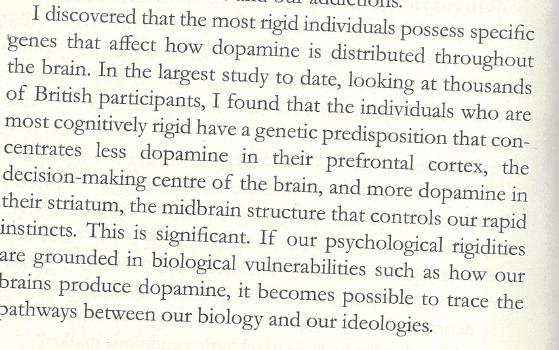
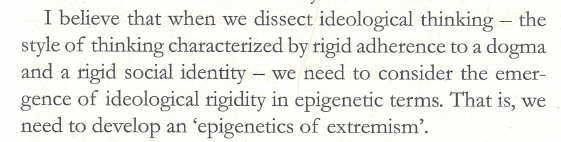
The nub of the book The Ideological Brain is the twelfth chapter ‘The Dogmatic Gene’. Here the concept of mental flexibility versus rigidity, within the context of some neuroscience on when and where our dopamine receptors are most active, or at least where there variation in a population shows that those with more mid-brain activity tend to be more hard and fast. [And, of course see no problem in doing that.]
The rest of the book shows a flexible thinker dealing with a (potentially) rigid fact’s variability in implication, and life’s contexts.
Flexibility contra ability – for example.
I’ll leave a pdf available of the entire chapter.
I’d like to compare the potentially real rigid fact of rigidity with some flexibility in dealing with the rigidity that is psychopathy.
Often one defining character of psychopathy and narcissism has been that it is irredeemable, unfixable, unhealable. At least within the expected lifespan of a human, perhaps even the lifespan of the universe. However I have just read an article which affects the possibility of that rigid fact, and discussions which Leor Zmigrod moves towards in their later chapters.
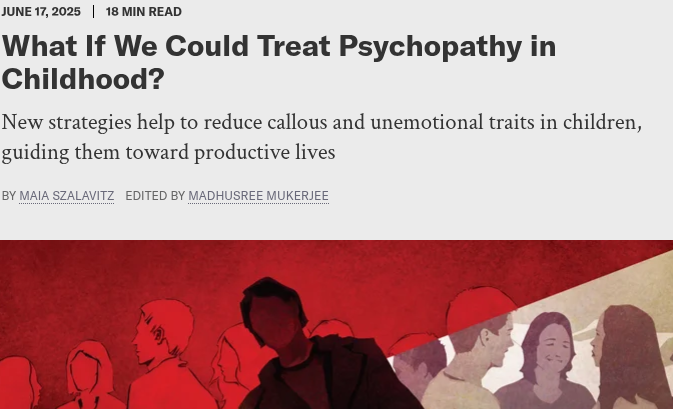
Szalavitz, Maia. 2025, July 1. ‘Psychopathic Traits in Children May Not Be Permanent After All’, Scientific American. Retrieved 1 August 2025 from https://www.scientificamerican.com/article/is-it-possible-to-treat-psychopathy-before-it-starts/. [PDF]
Sometimes flexible thinkers feel hunted down by rigid thinkers, and in response, if flexible thinkers world with love and hope, they think they can flex their way into ‘fixing’ the rigidity of their peers, but often they just create new pathways for rigidity to be enforced.
[I personally suspect this is the case because (not the only pathway) we do not ‘police’ narcissists enough from important places in our lives and societies. They say and believe any old shit to generate narcissistic supply so articles of faith in the good, let alone the faith of flexibility is unlikely to fix/save/cleanse anything without being aware of this.]
Also, remember super-rigid thinkers (socially contexted) do not believe flexible thinkers exist, they just think wrong-thinking peeps are wrong. So creating new wrongness per se does not get us anywhere with them. Such stereotyped thinking is, of course, an example of peeps just worlding their world with the abilities they have. Much like narcissists I guess, saying what they say, while often having to serve their more rigid thinking supporters.
So if the 'rigidity' of narcissism can be shifted in psychopaths and narcissists…hmmm… makes me re-think.
(and fixing psychopaths appears to be more likely with genetically predisposed psychopaths/narcissists rather than those who are brought up into that way of being)
What we are dealing with are orthogonal issues at an interplay. Rigidly aligning them gets us only so far.
Are those with a genetic predisposition to be bastards but with a suite of other genetic dispositions of flexibillity more likely to be amenable to be empathically nurtured, while those with stronger rigidity of thought style, more likely to stay fucked up, despite not strongly genetically predisposed to being a bastard.
Also, does being nurtured into narcissism harden one into rigidity elsewhere?
And how do we deal with that in policing narcissism, psychopathy and their baleful influence in suiting themselves (which is way more than just selfishness or individuality).
References:
Szalavitz, Maia. 2025, July 1. ‘Psychopathic Traits in Children May Not Be Permanent After All’, Scientific American. Retrieved 1 August 2025 from https://www.scientificamerican.com/article/is-it-possible-to-treat-psychopathy-before-it-starts/.
Zmigrod, Leor. 2025. The Ideological Brain: A Radical Science of Susceptible Minds. London: Penguin, Viking. ISBN 9780241741214
crossposted at substack.com