Stupidity, Dostoevsky & Glenorchy Boy
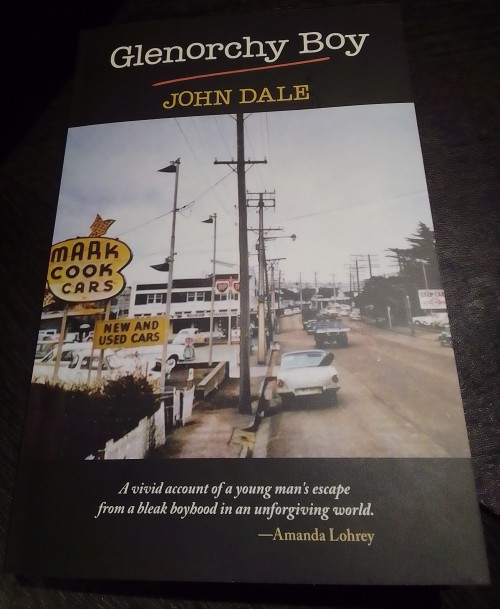
Recently I made some notes about stupidity, suspension of disbelief, and recent story-telling. They came up because this week I read Glenorchy Boy by John Dale. This is set centred on the northern suburbs of Hobart, Tasmania, of a lad coming into the grey zones of responsibility, relationships and restrictions. Mistakes are made, here and there, and avoided. Sort of. It’s of a generation ten years before mine, it feels like a century.
But the question of stupidity in stories smacking into my eye, first arrived in the stupidty of characters’ decisions when reading novels, particularly Dostoevsky's Crime and Punishment, they were so annoying, and this made the novels unreadable. I just sat in a sit-in of annoyance about the stupidity, and then I read Glenorchy Boy.
Basically I now saw, in looking back on my reading of Dostoevsky, I could not suspend my disbelief that anyone could be so stupid. And so much modern literature is based on that conceit in order to foist character development centre-stage into all stories. (See also my stuff on fables ( The fable that is modern literature & Parables of Submission, Fables of Truth-Based Creativity ).
The poet Coleridge invented that term ‘suspension of disbelief’ though I know it mostly via science fiction and fantasy literature’s critical discourses on world-building.
And Tolkien’s On Fairy Tales when I investigated:
“I once saw a so-called “children's pantomime,” the straight story of Puss-in-Boots, with even the metamorphosis of the ogre into a mouse. Had this been mechanically successful it would either have terrified the spectators or else have been just a turn of high-class conjuring. As it was, though done with some ingenuity of lighting, disbelief had not so much to be suspended as hanged, drawn, and quartered.”
Which pretty much sums up my experience with Dostoevsky, whose fans I always give a side-eye. You need that much stupidity in your tales? It makes a crystal palace look fine to me.
Anyway, soon after reading Glenorchy Boy I ran smack into this stupidty as a discourse. In reading Philip A. Glotzbach's What Hansel and Gretel Teaches Us About Moral Responsibility. 6 Oct. 2026 (Philip is not stupid, please don't take that away, this story is about me coming to terms with stupidity in stories).
I created a couple of notes, one for Glenorchy Boy:
In recent centuries real stories work if something stupid happens, even if the stupidity is unbelievable. Suspension of disbelief works across all genres. Stories exist to mend categories and maintain the effort virtues require. Narratives extenuate worlding.
and another expanding on that for Philip Glotzbach’s post on Hansel and Gretel:
Prior to the derivatives like these illustrative fallacies, we need to examine that many stories rely on a stupidity, which may or may not be recovered in the narrative arc. In recent centuries real stories work well if something stupid happens, even if the stupidity is unbelievable. Here, suspension of disbelief works across all genres. Stories exist to mend categories and maintain the effort virtues require. No stupidity - no story. Narratives extenuate worlding, in doing so they re-calibrate the social categories, especially in regard to grey zones and mist-adventures of their taxonomies. The narrative arc is a healing balm.
Here [ in Hansel and Gretel] the mother substitutes are wicked, but it is the father’s stupidity which gives us the story, i.e. suspending belief about the father’s stupidity allows the narrative to continue. Any fallacy is bolted on that narrative drive or structure. The story [fabula] is about the return to father. Now continue on with the fallacy work on moral responsibility. (Thus a meta-moral of the story in which the fairy-tale becomes an object lesson, but not about stupidity so much as featherbedding the fatherland.)
Basically if you cannot get past the stupidity of the father in the story (can you even remember him?) you’ll be feeling like I do about Dostoevsky's candle-burning characters. Why many readers indulge Dostoevsky in this regard is beyond my competence to understand. In Hansel and Gretel the true ogre is not put forward to centre-stage at all, while in Dostoevsky there is often only the centre stage and stupidity has been miss-cast as a stage.
Unlike Glenorchy Boy.
John Dale. Glenorchy Boy. Forty South Publishing, 2026, Hobart. https://shop.fortysouth.com.au/products/glenorchy-boy-by-john-dale-pb.
Philip A. Glotzbach. What Hansel and Gretel Teaches Us About Moral Responsibility. 6 Oct. 2026, https://www.persuasion.community/p/what-hansel-and-gretel-teaches-us.
J. R. R. Tolkien. “On Fairy-Stories.” Essays Presented to Charles Williams, 1947, Oxford.
Crossposted at substack.com