ritual embeddings, festive rants
Part 1 tilting
In the Assistens Kirkegård, a cemetery in Copenhagen, a monument to the Russian writer has been raised (Dostojevskij Monument Unveiled in Copenhagen) and they have a facebook page. Hence the repost by an FB friend of something who shared their post from a year ago, in which Fyodor Mikhailovich Dostoevsky describes a quote from Don Quixote, itself a metafictonal work, and then the quote.
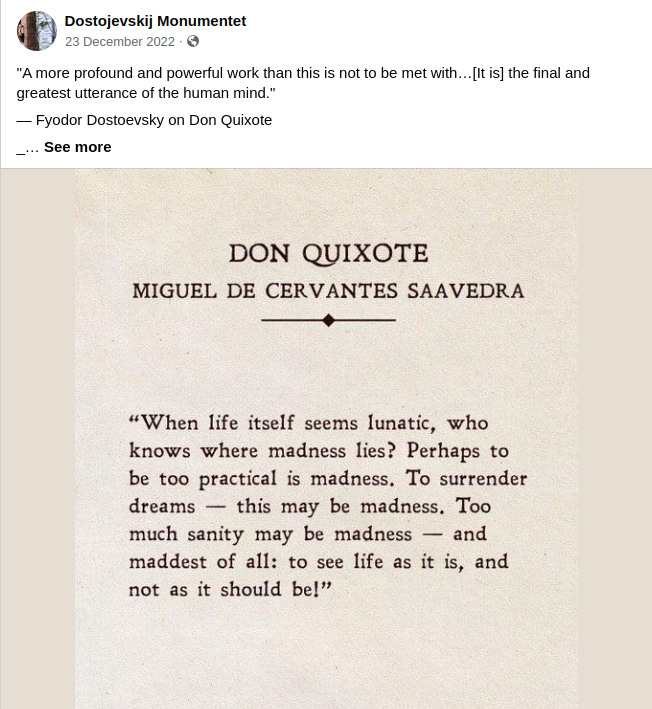
Now I do not have a lot of time for the racist writer of candle-burners (only posh elite Russian peeps could afford them… to read into the long winter nights), going on and on about some internal state of some tedious chap who has chosen to do the wrong thing for no apparent reason (I have met people who say this stuff is of comedic value, but I can’t see it, but then I am not a posh Russian aristocrat punching down on these lower upper middle upper lower types). On and on it goes. Apparently its part of the turn to psychology in literature, if so I can see that this is where fiction/story-telling/literature began to turn into the dreck that the only "good stuff" shows or should show… —some sort of pilgrim's progress where there is some psychological growth. Save me.
The key word there, and here, is should.
What should literature do? It should save us from those who cannot be saved. Anything else is a fantasy, all modern literature which uses this plot expectation of psychological change known as character development is actually pure fantasy which does not know its name.
And they they lived happily ever after, that what we should…. —why can’t we name this urge?
Life as it is? It is always shoulded, is it not?
It is indeed madness.
First posted in December 2023 on substack.com
Part 2 Should literature story the idiot as hero?
This started as a recurring rumination (yet again, see above) over about a week (in October 2025) doing fairly manual work with physically processing and storing books. Not many were literature in that rich sense of psychological fiction that some among us will credit or blame writers like Fyodor Dostoevsky for. Personally I have not seen much to gain in reading the spectacular detail of such imaginary lives, the insights are few and far between. Some say they can be read as humorous, but I do not like laughing at idiots. The detail is not thus a tedium, it is a story afterall, but too often it is simply punching down. (I’ll accept it is often self-deprecating, or confessional, like in the case of Dostoevsky, but this priest-like performance is not without a certain conflicted presence.)
My biggest issue is that without a serious error of judgment there is no story at all. Apparently, for some among us, great literature is raking over the ashes of life’s errors. Some type of poverty of the soul porn. Perhaps this is why I cannot write novels, I have a lack of letting gross mistakes inform the characters’ movements.
I do not enjoy the story of an idiot. I don’t laugh at them and I don’t identify with them. There is nothing to be gained here. Should I kill in order to be saved?
A softer description of this creative idiocy is to describe a character as flawed, often with a co-commitment of the Christianism of that character known as the ‘sinner’, using a framework of Christ’s passion, rather than empathy, about their damnable pathways to redemption through pain, or their failure to be redeemed, through pain. The idiocy is there to provide a necessary pivot to a salvation story without which they are just idiots doing stupid things for no reason at all.
I.E. such novels provide no help in worlding well at all, let alone warn us of threats to worlding well.
Conscience is an idiot grin. Similar to the way identity shrinks life into a type of suicide conscience shrinks the world into a soulful atomisations.
Fyodor Dostoevsky - Crime and Punishment = Преступление и наказание, in innumerable translations and editions some in the public domain.
John Carroll - Break-out from the Crystal Palace: The Anarcho-Psychological Critique; Stirner, Nietzsche, Dostoevsky. Routledge & K. Paul, 1974.
Both Nietzsche and Dostoevsky come from families of vicars or priests.