Josh Zlatus' "it works anyway"
Josh Zlatus reveals he has an “abiding passion” that let’s him begin on interest and activities like psychotherapy or literature, and then diving deeply and lengthily, but works them out like miner, and so finds them a little wanting. Only to go on.
So it goes.
I call that abode the world, and the passion is the life. We world the life but we forget the staging is a part of both. All the world, all the while.
Perhaps ‘worlding the life’ is simpler~better than ‘my’ Janus dancing-pair:
[selfing the world : worlding the self]
but then I am finding my way.
Josh's post is an excellent example of worlding, which we do anyway. And added to list of examples which I have not been adding to recently (and I still have to begin writing up ‘trajectory’ for the taphonomy of worlding) (finding my way).
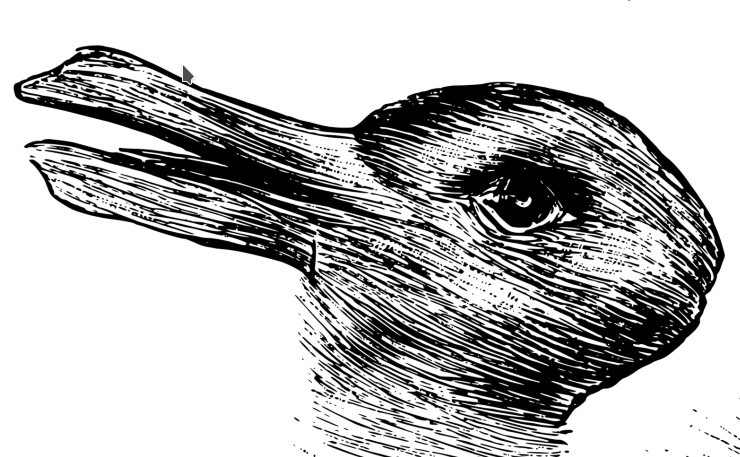
Josh's title “It works anyway” is truly great. This is a key duck-rabbit moment.
The moment pivots on ‘It’.
That is the world. It is there we do it, and even if we fail to recognise it or push it off into a meme of the subconscious, or a structuralist gnosticism. The world works a way anyway.
It works anyway. The world works a way anyway.
“It” in “It works anyway” almost has no referent at all, and perhaps, cannot be told.
Recently I noticed a cross-over in how I use ‘the world’ and the Taoist use of wu wei or way (of non-action), and have cribbed ‘the way that can be told is not the eternal way’ through to ‘the world that can be told is not the entire world” in a comment replying to Josh's post.
The connection here is that if it works anyway, then the action itself is less important than “something else”. The world is not just you selfing out your ways and means. Not that it is not you either, in whatever small way.
Josh’s experience with psychotherapy? It’s a framework or context of conversation, this is why Tarot ‘readings’ can work anyway, too.
We, in a certain modernity, have created the “social institution of the individual” so we often couch our experiences in terms of individual psychology. (What was an Imperial attempt to police believers with guilty consciences/souls down at the parish sermon and confessional level, became a pathology requiring a talking cure instead of masses.)
It might be better to look at ‘how it works anyway’ from a wider framework.
Similarly for literature, especially if one takes the viewpoint espoused in Carroll’s Break-out from the Crystal Palace: The Anarcho-Psychological Critique; Stirner, Nietzsche, Dostoevsky.
Literature is already an aggregate of empathy and experiences (LLMs just take that to the extreme potential by mapping all of that algorythmically, from the small worlds recorded in our social learning). An aggregate known as canon and sub-genre in tradition and revolt, within which the on-going development of the “social institution of the individual” takes place in each of us in the world.
A tradition or market of readers only recently focussed on character development (a bete noir of mine) and big name authors (a whatever of mine). Marketing requires individual career development as a recognizable trademark… but it is a publishing house of people and their readers that makes the book lover’s world a real place of escapism or learning, just as it took an empire to create in overreach a trajectory that give us the "social institution of the individual" in the first place
It works anyway, but never as the way intended, for empire or individuation.
Crossposted on substack.com
Zlatkus, Josh. “It Works Anyway.” Living Fossils. 15 April 2026 -- https://thelivingfossils.substack.com/p/it-works-anyway [Substack newsletter].
Carroll, John. Break-out from the Crystal Palace: The Anarcho-Psychological Critique; Stirner, Nietzsche, Dostoevsky. London; Boston: Routledge & K. Paul, 1974.