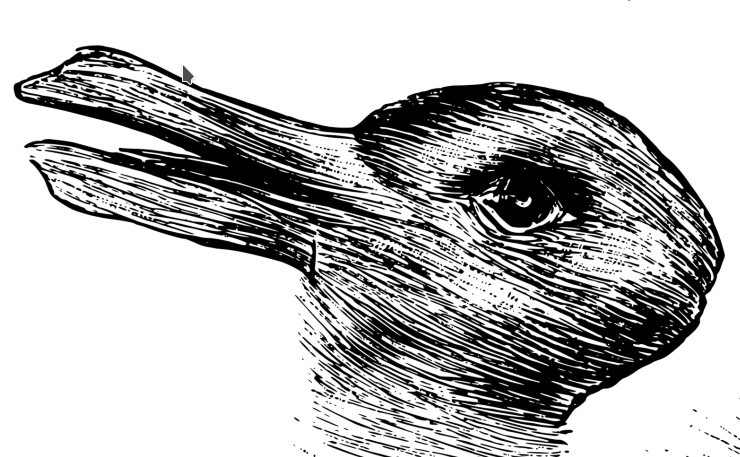
belief versus proposition
Originally posted on substack.com in February 2024.
It is perhaps a caricature of analytic philosophy that an analytic philosopher takes it for granted that beliefs are merely propositions that are held to be true. They use belief as a type of shortcut or shorthand for a whole world of formally logicked pain.
It is the analytic philosopher’s job to nut out that solution space. The problem space is framed by the dare-I-say belief that we are not careful enough thinkers. And hindsight is best discipline to mansplain our concerns.
There is a worthy hope here perhaps, to make the world a better place, maybe, by thinking better. Of course their first misstep is their use of the word belief.
In this environment of carefully constructed mechanical engineering, elements to be used include:
true beliefs
false beliefs, which can give rise to further elucidations
false consciousness
ideology
stupidity
cupidity
luxury beliefs (recent version in neo-Veblenism)
aliefs —which are not held as true, nor as false, nor imbetween, one acts as if they are true, even as one “knows” them to be not "true". (This coinage depends on the mental ecology in which belief=proposition that.)
There is a massive elision here between knowing and believing. All perfectly consistent with the initial suppositions used in this tradition.
“Belief” was originally used in the early medieval period to convince warlords or would-be ‘nobility’ in would-be England that this Christianity thing would make them Roman emperors too. And they had to explain to these practical cut-throats what church dogma was, and they likely looked around for somecommon understood cultural practices.
At this time belief/believing means ‘holding dear’ not ‘holding that’.
If we take this context and not the later shorthand version, we see that what was important was an act of loyalty. Feudal power structures were bound by acts of fealty. This cultural practice was used to explain what church dogma were, an act of mental committment. An intentional stance to be sure but not really about whether chairs and tables are 'there'.
Compare this emotional commitment to the origins of the Greek dogma in 'opinion'.
Belief is often use to translate the Greek term δοκεῖ ‘it seems that’, and you can see how philosophers moving from the Greek texts (or the tradition to read Greek was lost inthe west where these pactical cut-throat were being sold a system of control) and so glossed over the loyalty inherent in the medieval term belief/believing which means to ‘hold dear’ as an act of fealty.
Loyalty in feudal realities were based on relationships with more powerful warriors and/or slavers. Ancient city-life and it’s marketplace of opinions ‘it seems that’ are not welcomed in an army camp on the move to domination.
One ‘holds dear’ ('believe' is a form of be-loved) not because they are true propositions, but because more powerful people see your beliefs as a type of mental uniform, and can work out which side you are on. Loyalty structured the medieval world, not opinions. This is how ‘it seems that’ comes to mean dogma. An order you must follow.
The English word belief is an outcome of this non-philosophical process.
The common ground between warrior lords and priests is that primary virtue obedience.
Centuries later this remains in thought, but the loyalty has been subsumed into 'consistency' based on logical mechanical hindsights, and no longer is the sought-for consistency based on emotional commitments (to a leader in the guise of professed acts of loyalty (held dear) as co-commitment of devotee-ist relationship with a sacrificed but risen-again son as mediated by the church). As if that could cohere order into society and thus save the world, because it (the world and all in it) would all be obedient to who-ever represented this god.
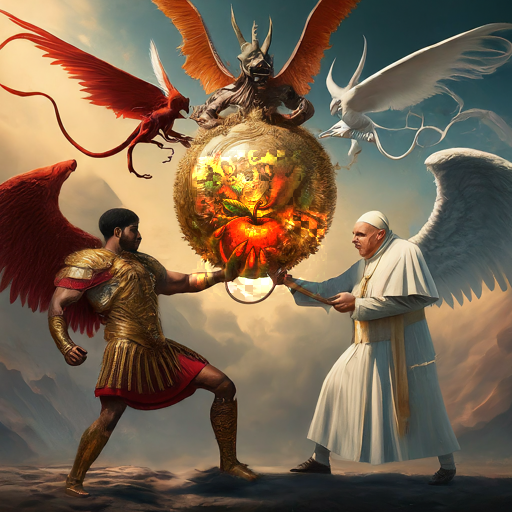
For centuries, emperors and popes would argue who was best fit to do this job. In Orthodox Christianity the emperor is in charge as that how the Emperor chose his version of Christianity. Roman Catholics are an Orthodoxy gone rogue.
Warlords find the idea of obedience very attractive. Loyalty is a means of achieving obedience. Obedient meat-waves are a means of achieving control of the world. The world, like the self, is mostly in our heads, so that where beliefs operate. Otherwise no one will march anywhere.
If a warlord knows what you hold dear he can control your actions, might as well get all those loyal subjects working to the same 'script'. The uniformity makes it easier to manage ‘things’. Monotheism is merely rearranging things so we all used the same mental railway gauge, so we can get the trains to run on time towards the next battlefront. Monotheism is a technology of empire. (see also Alignment)
Analytic philosophers take the ideas in that feudal cultural baggage, that 'script', without a lot of care, and take those now commonplace equivalences that common parlance makes over centuries when using the word belief, and see that as the basis for explaining or managing logic through true beliefs/loyalties about reality. It replaces obedience as a practical implement of power, with some logical notion of explaining what on earth is going on. Beliefs can do no such thing.
I do not think that word belief means what you think it means.
No wonder we have laws of nature. No wonder peeps argue about what is natural in order to make our shared world fit (align) their preferred world. No wonder narcissistic leaders see those preferences and fears as an opportunity, and that’s why psychopaths are more concerned about loyalty than truth, for them 'truth' is just a shibboleth to test who should be hurt first for disloyalty.
Beliefs are bad worlding through and through.